
House of Many Colors Olynthus |
A Future for the Past
Back in the mid-1990s, many companies imagined how the then new online virtual reality environments could be used to change the way history is taught in schools to engage and excite students about peoples, places, and events of the past.In 1998, as a research and development project that could possibly lead to a new type of educational tool, Learning Sites began to look for a suitable building that would complement its existing Vari House teaching package. Since the structure at Vari was a farmhouse, it was decided to search for an urban dwelling. Some research and consultation led to the decision to model and convert into virtual reality data from the House of Many Colors from Olynthus, based on excavated reports and the analyses of Nicholas Cahill.
The Canvas
The House of Many Colors is one of the villas built in the newly expanded Residential Section of ancient Olynthus, Greece. The house was excavated by American archaeologists David M. Robinson and Lloyd Daly in 1938, during the last season of field work by the Johns Hopkins University expedition at the town of Olynthus. The House of Many Colors abuts an unexcavated house on one side, has streets on two sides, and an alley on the fourth. The defensive walls of the city seem to have run along the East Spur Hill, and thus this Villa Sector was outside their protection.The House of Many Colors is nearly square, measuring 17 x 17m (about 18.5 yards square). It had a second story, little of which has survived, that was reached by a wooden staircase up from Room ‘l’. A row of four rooms lies to the north of Corridor ‘e’. The central small courtyard (‘i”) is surrounded by several more rooms. The house directly abuts another house on the west that has not been excavated, and a narrow alley separates the house from Villa CC to the south.
click on the lettered callouts for a detail of the area |
Plan of the House of Many Colors; adapted from N. Cahill, 1991; used with permission |
The excavators found the ground floor of the House of Many Colors to be especially well-preserved. The lower portions of many of the walls of the house are of rough fieldstone, and most stand to a height of half a meter. Of special interest to the excavators was the evidence of interior decorating. In the fallen debris from the upper story and in places still on the lower walls were found large sections of colored and painted stucco that once covered the walls. Vibrant colors were used, including blue, red, orange, white, and various shades of yellow, sometimes with incised lines for added decorative effect. Some rooms had a baseboard of a different color from the walls. Colorfully decorated walls were found in (c), (d), (e), (f), (i), (k), and (l). Thus, the excavators choose 'Many Colors' as the name of house; it was the most elaborately painted house found at Olynthus.
VRML
Requires the Cortona3D Viewer (PC) - learn more about VRML and the plugins
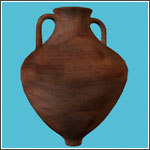 Pithos
VR model of a pithos like those found in the storeroom ‘m;’
model courtesy of © 1999 Learning Sites, Inc.
click to load the VRML model
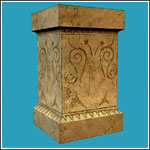 Altar
VR model of one of the small marble altars found in Room ‘e;’
model courtesy of © 1999 Learning Sites, Inc.
click to load the VRML model
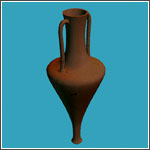 Amphora
VR model of one of the amphoras found in Room ‘e;’
model courtesy of © 1999 Learning Sites, Inc.
click to load the VRML model
Reference
Page Created: January 3, 2004
Page Updated: January 14, 2012
URL:
Page Author: The Institute for the Visualization of History