
Tsoungiza Greece |
All Ages
The hill of Tsoungiza had been excavated in 1924 by Carl Blegen and then in 1927 and 1928 by James Harland, but their work had never been fully published. Yet from these previous investigations, the site was known to hold settlements of the Neolithic and Early and Late Bronze Ages. The renewed Tsoungiza excavations of the Nemea Valley Archaeological Project were directed by James C. Wright and sponsored by Bryn Mawr College under the auspices of the American School of Classical Studies at Athens. Between 1979 and 1986, the NVAP team explored the extent of the settlement over the hillside and refined our understanding of the periods of occupation. The results of this new work have produced evidence for the following periods of habitation: Neolithic (Early, Middle, and Final phases), most phases of the Early Bronze Age, the very end of the Middle Bronze Age, all phases of the Late Bronze Age.click on the images to enlarge
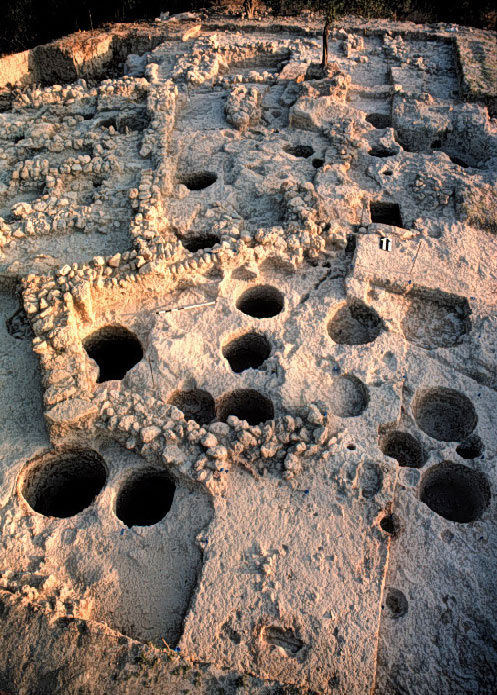
NVAP Tsoungiza excavations in progress in trench EU5; © 1986 Nemea Valley Archaeological Project; used with permission. |
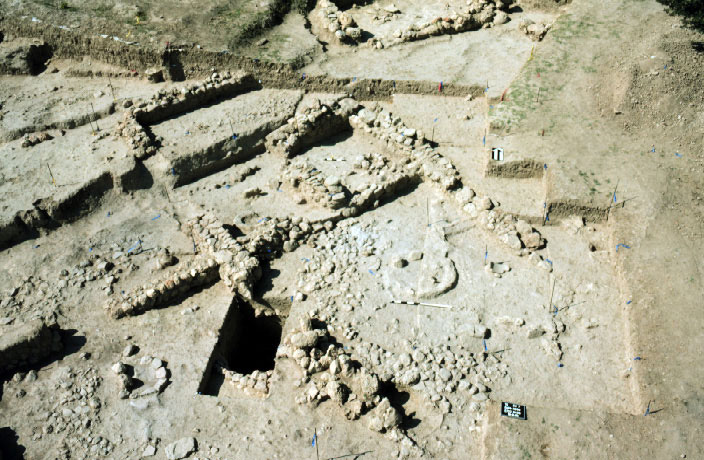 NVAP Tsoungiza excavations in progress in trench EU7; © 1986 Nemea Valley Archaeological Project; used with permission. |
All Access
From the start, the NVAP team collected data with the goal of creating a new and more comprehensive type of final report. They decided that multimedia publication of the NVAP results would have numerous advantages. The large scope and interdisciplinary nature of the project created information (ranging from text and raw artifact data to hundreds of photographs and drawings) that would not suit the linear structure of a traditional printed publication. The large quantity of data and images generated is not economically reproducible in printed form, nor would all readers need to access all the available information. Beginning in 1984, NVAP's recording system was designed for and used computers. With the availability of hypertext, image retrieval software, and virtual reality, the Nemea Valley Archaeological Project prepared to produce an interactive publication that would make information in many media accessible to many types of users at many levels. To this end, NVAP collaborated with Learning Sites, Inc., a specialist in interactive educational and research packages with expertise in the digital reconstruction of ancient sites, to create an innovative multimedia publication available on DVD and via the Internet for global access to vast amounts of the excavated data, far beyond standard reports.click on the crosshairs to drag the site view window |
Site plan of the excavation trenches during the NVAP work at Tsoungiza. ©1997 Nemea Valley archaeological Project and Learning Sites; used with permission |
Reference
Page Created: February 10, 2004
Page Updated: February 14, 2005
URL:
Page Author: The Institute for the Visualization of History